Why AI-Native Agencies Will Dominate Marketing in 2026
Traditional agencies are built for a world that no longer exists. AI-native agencies deliver faster execution, better results, and 40-60% lower costs. Here's exactly how—and what it means for your marketing.
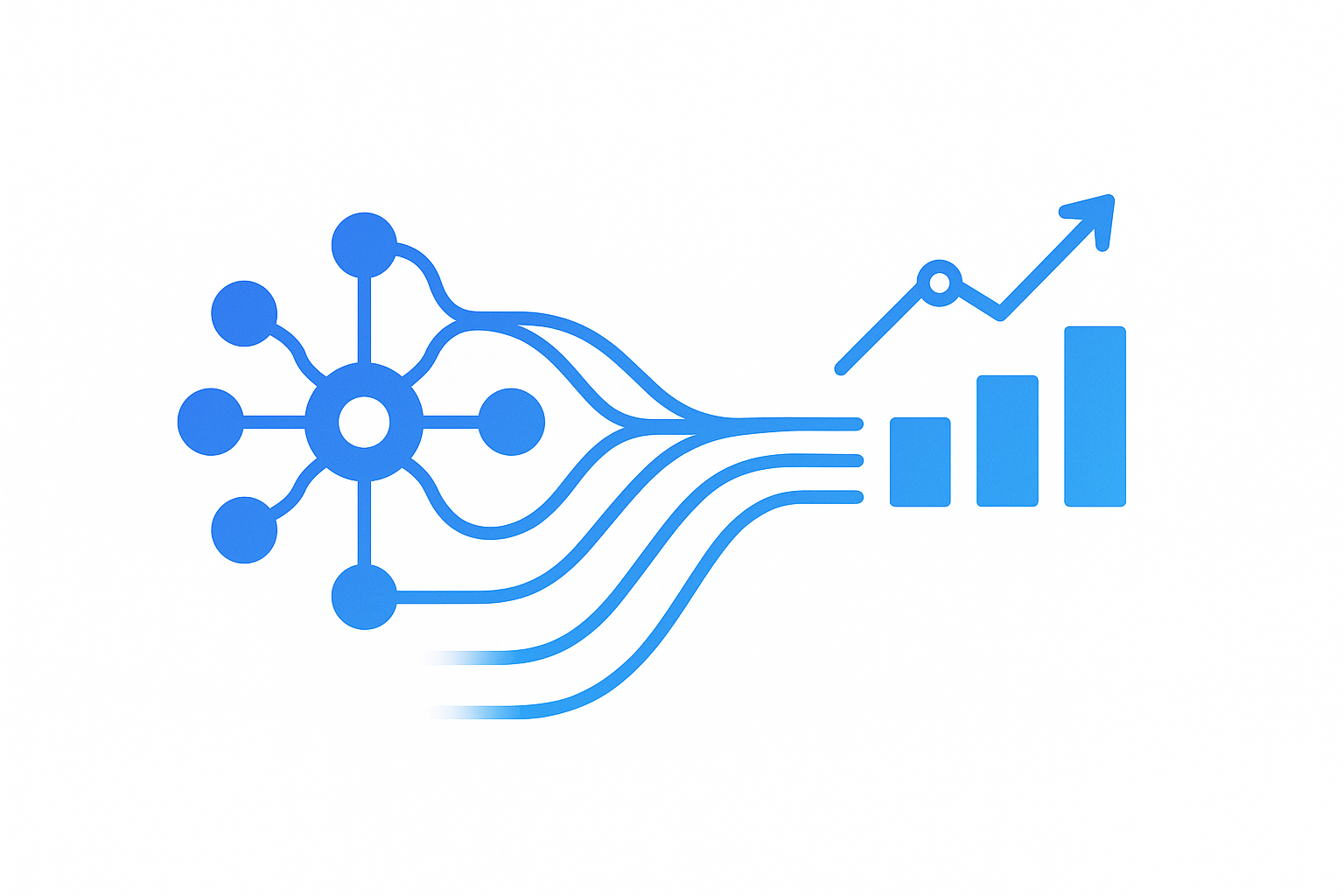
The marketing agency model hasn’t fundamentally changed since the 1960s. Layers of account managers, creative directors, media buyers, and strategists—all billing by the hour, all incentivized to make projects take longer than they need to.
In 2026, that model is collapsing. AI-native agencies—built from the ground up around artificial intelligence—are delivering better results, faster execution, and dramatically lower costs. And the gap is widening every quarter.
Key Takeaways
- AI-native agencies deliver campaigns 5-10x faster than traditional shops
- Operating costs are 40-60% lower, with savings passed to clients
- Humans focus on strategy and creative direction; AI handles execution at scale
- Traditional agencies that don’t adapt will lose clients to AI-native competitors within 18 months
- The shift isn’t coming—it’s already happening
What Is an AI-Native Agency?
An AI-native agency is not a traditional agency that “uses some AI tools.” It’s a fundamentally different operating model where AI is the execution layer and humans are the strategic layer.
Here’s the distinction:
| Dimension | Traditional Agency | AI-Native Agency |
|---|---|---|
| Execution speed | Weeks per campaign | Hours per campaign |
| Content volume | 5-10 pieces/week | 50-100+ pieces/week |
| A/B testing | 2-3 variants per cycle | 20-50 variants simultaneously |
| Scaling | Hire more people | Deploy more compute |
| Cost structure | High fixed overhead | Variable, usage-based |
| Reporting | Monthly PDF decks | Real-time dashboards |
| Iteration cycle | 2-4 weeks | Same-day |
The result is a fundamentally different value proposition for clients: more output, faster delivery, better optimization, at significantly lower cost—delivering measurably better ROI than traditional models.
Why the Traditional Agency Model Is Breaking
Before we look at why AI-native wins, let’s be honest about why traditional is losing.
The Billable Hour Problem
Traditional agencies make money when projects take longer. The entire incentive structure is misaligned with client outcomes. A campaign that could ship in 3 days gets stretched to 3 weeks because that’s how the revenue model works.
According to industry benchmarks, the average agency utilization rate is 60-65%. That means for every dollar you pay, roughly 35-40 cents goes to non-billable overhead—internal meetings, admin, status updates, and process.
The Handoff Tax
A typical campaign at a traditional agency passes through 5-7 people before it goes live:
- Client brief → Account Manager
- Account Manager → Strategist
- Strategist → Creative Director
- Creative Director → Copywriter/Designer
- Copywriter/Designer → Account Manager (review)
- Account Manager → Client (approval)
- Client feedback → repeat steps 2-6
Each handoff adds time, miscommunication risk, and cost. Research shows that knowledge transfer between individuals loses 10-30% of context per handoff. By the time your campaign is live, it may barely resemble what you actually needed.
The Talent Bottleneck
Great marketers are expensive and scarce. Traditional agencies compete for the same talent pool, driving up salaries and overhead. When your senior strategist leaves, their institutional knowledge walks out the door.
AI-native agencies sidestep this entirely. The AI doesn’t quit, doesn’t need onboarding, and doesn’t lose institutional knowledge. Human strategists focus on what they do best—thinking, directing, and building relationships—while AI handles everything else.
The Five Advantages of AI-Native Agencies
1. Speed That Changes the Game
Speed isn’t just a nice-to-have in performance marketing. Speed is competitive advantage. The faster you test, learn, and iterate, the faster you find what works—and scale it before competitors catch up.
Here’s what speed looks like in practice:
- Campaign launch: From brief to live ads in hours, not weeks
- Creative production: 50 ad variants generated and tested in the time it takes a traditional agency to produce 5
- Market expansion: Adding a new geographic market takes days, not months
- Performance optimization: Real-time bid adjustments and creative rotation, not monthly strategy reviews
At wieldr, we’ve seen clients who previously waited 3 weeks for a campaign refresh get same-day turnarounds. That’s not an incremental improvement—it’s a category change.
2. Scalability Without Linear Cost Increases
Traditional agencies scale by hiring. AI-native agencies scale by deploying more compute.
The math is simple:
- Traditional agency expanding from 3 channels to 8 channels: Hire 3-5 new specialists. Timeline: 2-3 months for recruiting, onboarding, and ramp-up. Cost increase: $200K-400K/year in salaries.
- AI-native agency expanding from 3 channels to 8 channels: Configure new automation workflows. Timeline: 1-2 weeks. Cost increase: Marginal.
This is why AI-native agencies can offer multi-channel marketing across Meta, LinkedIn, Google, TikTok, and more—without the astronomical retainers that traditional shops charge.
3. Data-Driven by Default, Not by Afterthought
Traditional agencies treat data as something to package into a monthly report. AI-native agencies treat data as the operating system for every decision.
The difference matters:
- Real-time analytics replace monthly PDF decks
- Predictive modeling identifies opportunities before they’re obvious to humans
- Automated anomaly detection catches budget waste, underperforming creatives, and audience fatigue in real time
- Cross-channel attribution shows the full customer journey, not just last-click data
When data drives every decision, waste goes down and performance goes up. It’s that simple.
4. Better Human Work, Not Less Human Work
The biggest misconception: AI-native agencies replace humans with robots.
The reality: AI handles the repetitive, scalable, low-judgment work—freeing humans to focus on high-leverage strategy, creative direction, and client relationships.
What AI does:
- Generates ad copy variants and creative iterations
- Manages bid strategies and budget allocation
- Produces SEO content and email sequences
- Builds performance reports and dashboards
- Monitors campaigns 24/7 for anomalies
What humans do:
- Define brand positioning and messaging strategy
- Set creative direction and approve key assets
- Build client relationships and understand business context
- Make strategic decisions about market expansion and budget allocation
- Identify opportunities that require industry expertise and judgment
The result: clients get senior-level strategic thinking at every touchpoint, not junior coordinators copying data into spreadsheets.
5. Cost Efficiency That Compounds Over Time
AI-native agencies aren’t just marginally cheaper. They’re structurally cheaper because the operating model is fundamentally more efficient.
Where the savings come from:
- No bloated overhead: No expensive office leases for 200 people, no layers of middle management
- No artificial project padding: Work takes the time it actually needs
- No scope creep surcharges: Adding a new market or channel is a configuration change, not a contract renegotiation
- No redundant tooling costs: AI-native workflows replace 10+ point solutions with integrated systems
Industry data suggests AI-native agencies operate at 40-60% lower cost than equivalently scoped traditional agencies. Those savings get passed to clients as either lower retainers or significantly more output for the same budget.
Who Benefits Most from AI-Native Agencies?
AI-native agencies aren’t the right fit for every company. They’re ideal for:
- Startups scaling from Series A to Series C who need to move fast and can’t afford traditional agency overhead
- SaaS companies running multi-channel acquisition across paid, organic, and content
- E-commerce brands managing high-volume creative automation and channel optimization
- Mid-market companies that need enterprise-level marketing without enterprise-level budgets
- Global businesses expanding into new markets and needing rapid localization
If your marketing needs are primarily brand campaigns with 6-month timelines and premium production budgets, a traditional creative agency may still be the right fit. But if you need performance, speed, and scalable execution—AI-native wins.
The Market Is Moving Fast
This isn’t a theoretical future. The shift to AI-native marketing is happening right now:
- Y Combinator listed “AI-native agencies” as a top request for startups (RFS #3 in their 2026 batch)
- In-house marketing teams are adopting AI-first workflows, making traditional agencies redundant for many functions
- Private equity firms are investing in AI-native models, recognizing the operating leverage
- Client expectations have shifted—CMOs increasingly ask “how do you use AI?” in agency pitches
Traditional agencies have two paths:
- Rebuild around AI: Painful, expensive, and requires admitting the old model is obsolete
- Decline gradually: Keep billing hours while clients quietly move to faster, cheaper alternatives
Most will choose path #2. Not because they’re wrong, but because organizational inertia is the most powerful force in business.
How to Evaluate an AI-Native Agency
Not every agency claiming to be “AI-powered” actually is. Here’s how to separate real AI-native shops from traditional agencies with a ChatGPT subscription:
Ask these questions:
- “What’s your typical turnaround time from brief to live campaign?” Real answer: hours to days. Red flag: “2-3 weeks.”
- “How many creative variants do you test per campaign?” Real answer: dozens to hundreds. Red flag: “3-5 per round.”
- “How do you report on performance?” Real answer: real-time dashboards with anomaly alerts. Red flag: “Monthly PDF reports.”
- “How does your team structure work?” Real answer: Senior strategist + AI execution layer. Red flag: Account Manager → Creative Director → Junior Designer.
- “What happens when I want to add a new channel or market?” Real answer: Configure and launch within days. Red flag: “Let’s scope that as a separate project.”
What This Means for Marketing Teams
If you’re a CMO or marketing leader: Stop evaluating agencies on reputation and start evaluating them on operating model. The agencies that will deliver the best results over the next 3-5 years are the ones built around AI from day one.
If you’re a marketer at a traditional agency: Start building AI skills now. The professionals who understand both marketing strategy and AI-powered execution will lead the next generation. The ones who don’t will struggle to stay relevant.
If you’re a founder or CEO: Your marketing budget should be buying outcomes, not hours. AI-native agencies deliver more outcomes per dollar. The math is simple.
FAQ
How much does an AI-native agency cost compared to a traditional agency?
AI-native agencies often have a different cost structure than traditional retainers because more of the work can be systematized: research, variant production, reporting, QA, and repetitive campaign operations. The useful question is not whether the retainer is cheaper in isolation. It is whether the operating model produces more useful learning, faster iteration, and better decisions per dollar.
Will AI replace all human marketers?
No. AI replaces repetitive execution tasks—not strategic thinking, creative direction, or client relationships. The best AI-native agencies pair senior human strategists with AI execution, delivering better strategy AND better execution.
Is AI-native marketing only for tech companies?
Not at all. AI-native agencies serve e-commerce, healthcare, financial services, real estate, and many other industries. Any company running performance marketing benefits from faster execution and better optimization.
How do I know if my current agency is actually using AI effectively?
Ask for specifics: How many creative variants are they testing? What’s their campaign turnaround time? Do they have real-time reporting? If the answers sound like a traditional workflow with “ChatGPT” sprinkled on top, they’re not truly AI-native.
What’s the risk of working with an AI-native agency?
The main risk is choosing a shop that’s “AI-native” in branding only. Look for agencies with transparent processes, real-time reporting, and a clear explanation of how AI fits into their workflow. Also look for human strategic oversight—AI without human direction produces average work at scale.
If you are trying to build a more useful growth operating system, talk to Wieldr about where the current workflow is getting stuck.
Related reading: The Multi-Channel Playbook for 2026 · From Startup to Scale: Marketing That Grows With You
Key Terms in This Article
ROI
Return On Investment – the profitability of your marketing investment.
API
Application Programming Interface – how different software systems connect and share data.
KPI
Key Performance Indicator – a measurable value that shows how effectively you're achieving objectives.
SEM
Search Engine Marketing – paid advertising on search engines like Google.
SEA
Search Engine Advertising – same as SEM, primarily used in Europe.
CRO
Conversion Rate Optimization – systematically improving the percentage of visitors who convert.
Related Services
Related Articles
The Multi-Channel Marketing Playbook for 2026
Running campaigns across Meta, LinkedIn, Google, TikTok, and more doesn't have to be chaos. Here's a complete framework for building a coordinated, data-driven multi-channel strategy that scales.
From Startup to Scale: The Marketing Playbook for Every Growth Stage
Your marketing strategy at seed stage won't work at Series B. Here's exactly how to evolve your approach at each funding stage—channels, budget splits, team structure, and the mistakes that kill growth.
Need help turning this into a system?
Wieldr works with selected teams on strategy, paid media, measurement, creative testing, and AI-native marketing workflows.
Work with Wieldr