The Multi-Channel Marketing Playbook for 2026
Running campaigns across Meta, LinkedIn, Google, TikTok, and more doesn't have to be chaos. Here's a complete framework for building a coordinated, data-driven multi-channel strategy that scales.
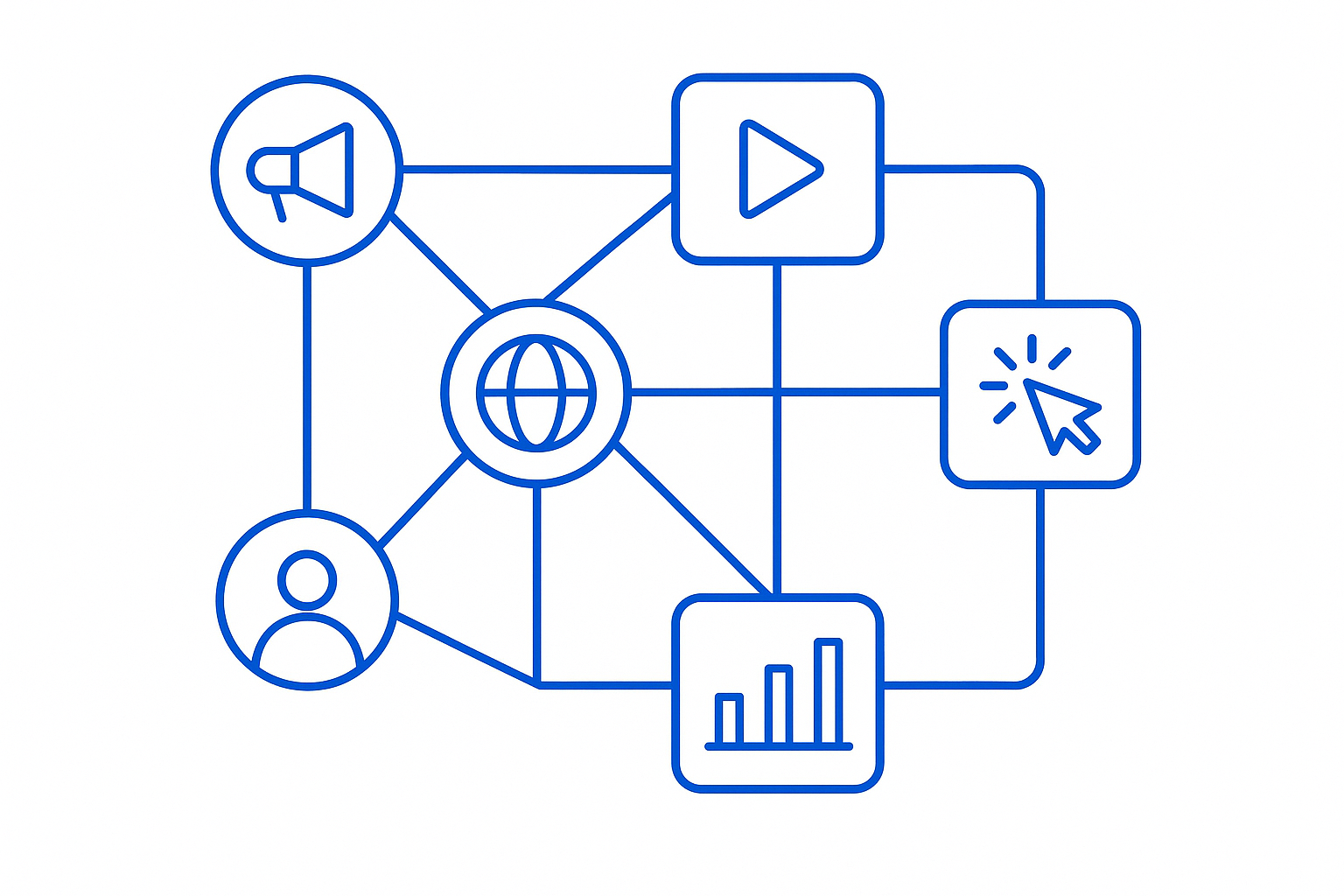
Most companies treat each marketing channel as an isolated silo. Different teams, different budgets, different strategies, different reporting. Meta over here. Google over there. LinkedIn somewhere in between. Nobody knows which channel actually drives results, and the customer experience is fragmented at every touchpoint.
This is how marketing budgets get burned. Not in one dramatic fire, but in a slow, invisible leak of wasted spend, duplicated effort, and missed opportunities.
Multi-channel marketing done right is a coordinated system—where every channel has a defined role, data flows freely across platforms, and strategy evolves based on real performance data, not gut feelings.
Here’s the complete playbook for building that system in 2026.
Key Takeaways
- Multi-channel success requires a system, not a collection of silos
- Map every channel to a specific funnel stage: demand creation, demand capture, or retargeting
- Start with 2-3 core channels, prove ROI, then expand
- Cross-channel attribution is non-negotiable—without it, you’re flying blind
- Coordinate messaging across channels for a unified brand experience
- Speed of iteration is the single biggest competitive advantage
Why Multi-Channel Marketing Matters More Than Ever
Consumer attention is more fragmented than at any point in history. The average person interacts with 6-8 marketing channels before making a purchase decision. They see your Meta ad on Instagram, research you on Google, check your LinkedIn company page, read a review, and then convert through an email sequence.
If your channels aren’t coordinated, each of those touchpoints feels like a different company. And when the experience is disjointed, trust erodes.
The companies winning in 2026 aren’t the ones spending the most. They’re the ones with the most coordinated systems—where every dollar works harder because every channel reinforces the others.
The Channel Classification Framework
Before building a strategy, you need a taxonomy. Not all channels serve the same purpose, and treating them equally is a recipe for wasted budget.
Demand Creation Channels
These channels reach people who don’t yet know they need your product. They build awareness, generate interest, and fill the top of the funnel.
| Channel | Best For | Typical CPM | Audience Quality |
|---|---|---|---|
| Meta (Facebook/Instagram) | Broad awareness, storytelling | $8-15 | High (interest targeting) |
| TikTok | Viral reach, younger demographics | $5-10 | Medium-High (behavior-based) |
| YouTube | Long-form education, product demos | $10-20 | High (intent signals) |
| Snapchat | Gen Z/Millennial reach | $3-8 | Medium (demographic) |
| Niche communities, authentic engagement | $5-12 | High (community-based) |
Success metrics: Reach, impressions, video completion rate, engagement rate, cost per landing page visit.
Demand Capture Channels
These channels target people actively searching for a solution. They have intent. Your job is to show up when they’re ready to decide.
| Channel | Best For | Typical CPC | Intent Level |
|---|---|---|---|
| Google Search | High-intent keyword capture | $2-15 | Very High |
| Microsoft Ads (Bing) | Lower-competition search | $1-8 | High |
| Amazon Ads | E-commerce product search | $0.50-3 | Very High |
| LinkedIn Lead Gen | B2B decision-maker targeting | $5-25 | High |
| Visual discovery, shopping | $0.50-2 | Medium-High |
Success metrics: Click-through rate, conversion rate, cost per acquisition, return on ad spend.
Retargeting & Nurture Channels
These channels re-engage people who’ve already shown interest but haven’t converted yet.
- Meta Retargeting: Re-engage website visitors, video viewers, abandoned carts
- Google Display Retargeting: Banner ads across the Google Display Network
- Email Marketing: Automated drip campaigns, offers, and newsletters
- LinkedIn Retargeting: Re-engage website visitors with professional context
Success metrics: Retargeting conversion rate, cost per conversion, email open/click rates, assisted conversions.
Building a Coordinated Multi-Channel Strategy: Step by Step
Step 1: Map the Customer Journey
Start by documenting how your ideal customer moves from awareness to purchase. Interview customers, analyze your CRM data, and map the typical path:
- Awareness: How do prospects first hear about you? (Social ads, organic search, referrals, content)
- Consideration: How do they evaluate you? (Website visits, competitor research, reviews, case studies)
- Decision: What triggers conversion? (Demo requests, free trials, consultations, offers)
Then assign channels to each stage:
- Awareness: Meta, TikTok, YouTube, organic social media, SEO content
- Consideration: Google Search, LinkedIn, retargeting, content marketing
- Decision: Email, retargeting, direct sales outreach
Step 2: Establish Cross-Channel Measurement
This is where most multi-channel strategies die. Without unified measurement, you can’t optimize.
The attribution stack you need:
- UTM parameters on every link: Non-negotiable. Every ad, every email, every social post needs UTM tags for source, medium, and campaign tracking.
- Google Analytics 4 (GA4): Cross-platform tracking, funnel analysis, and audience building. Configure it properly—default GA4 setup misses critical data.
- CRM integration: Connect ad platforms (Meta, Google, LinkedIn) to your CRM. Track revenue, not just leads. A $50 lead that never converts is worth less than a $200 lead that closes $50K.
- Unified dashboard: Bring all channel data into one view. Whether it’s Looker, Tableau, or a custom analytics solution—one dashboard, one source of truth.
Attribution model selection:
- Last-click attribution over-credits bottom-of-funnel channels (Google Search gets credit for leads that Meta actually created)
- First-click attribution over-credits top-of-funnel channels
- Multi-touch attribution (MTA) distributes credit across the full journey—it’s the gold standard, but requires enough data volume to be statistically meaningful
- Incrementality testing measures true lift by running controlled experiments—the most reliable method for high-spend accounts
For most companies running $10K-100K/month in paid media, start with data-driven attribution in GA4 and graduate to incrementality testing as spend increases.
Step 3: Start with 2-3 Core Channels
Resist the temptation to launch on every platform at once. A $20K/month budget spread across 8 channels means you’ll never reach the data threshold needed to optimize any of them.
Recommended starting combinations:
For B2B SaaS:
- LinkedIn Ads (demand capture) + Google Search (high intent) + Retargeting (nurture)
- Budget split: 40% LinkedIn, 35% Google, 25% Retargeting
For E-commerce:
- Meta Ads (awareness + retargeting) + Google Shopping (capture) + Email (repeat purchase)
- Budget split: 45% Meta, 35% Google, 20% Email/Retargeting
For Startups (limited budget):
- Meta Ads (awareness) + Google Search (intent) + Organic LinkedIn (thought leadership)
- Budget split: 50% Meta, 40% Google, 10% Content production
The rule: Get each core channel to positive ROI before expanding. Adding channels before you’ve optimized existing ones just multiplies inefficiency.
Step 4: Coordinate Messaging Across Channels
Disjointed messaging across channels is the fastest way to confuse prospects and erode trust. Your Meta ads shouldn’t look like a different company from your Google landing pages.
The messaging framework:
- Define one core narrative that works across all channels
- Adapt the format to each platform (video for TikTok, carousel for Instagram, text-heavy for LinkedIn)
- Maintain consistent visual identity (colors, typography, imagery style)
- Sequence messaging by funnel stage (awareness ads → educational content → social proof → offer)
Example: A SaaS product launch
- Meta: 15-second video showing the product solving a real problem. Benefit-driven headline. Drive to landing page.
- LinkedIn: Thought leadership post from the CEO explaining the problem the product solves. Sponsored to amplify.
- Google Search: Bid on product category keywords + branded terms. Landing page matches the Meta ad experience.
- Retargeting: Show customer testimonials and case studies to people who visited but didn’t convert.
- Email: Announcement to existing list with exclusive early-access offer.
Same campaign. Consistent messaging. Each channel plays its role.
Step 5: Build a Testing and Iteration Engine
Multi-channel marketing is not “set it and forget it.” It’s a continuous optimization loop:
- Launch campaigns with defined hypotheses
- Analyze performance by channel, audience, and creative
- Identify winners and double down
- Kill underperformers and reallocate budget
- Test new hypotheses based on data insights
- Repeat weekly (not monthly)
The speed advantage: Companies that run this loop weekly outperform those who run it monthly. The faster you iterate, the faster you compound learnings. This is where AI-native agencies have a structural advantage—they can run this loop in hours, not weeks.
The Five Most Common Multi-Channel Mistakes
Mistake #1: Spreading Budget Too Thin
Running 8 channels with $10K/month total budget means $1,250 per channel. That’s not enough data to optimize anything. You’ll make decisions based on noise, not signal.
Fix: Focus on 2-3 channels. Prove ROI. Then expand systematically.
Mistake #2: Treating Channels as Competing Silos
When each channel is measured in isolation, they appear to compete for credit. “Meta generated the lead” vs “Google closed the deal”—but in reality, the customer touched both.
Fix: Implement cross-channel attribution. Measure the full journey, not individual touchpoints.
Mistake #3: Ignoring the Awareness-to-Conversion Lag
B2B buying cycles average 3-6 months. If you’re measuring Meta awareness campaigns on a 7-day window, you’ll always conclude they don’t work. They do—you’re just measuring wrong.
Fix: Match your attribution window to your actual sales cycle. Use cohort analysis to track leads from first touch to close.
Mistake #4: Inconsistent Creative and Messaging
Your Meta ads use one visual style. Your Google landing pages use another. Your LinkedIn posts sound like a completely different company. Prospects notice.
Fix: Build a brand playbook with consistent tone, messaging pillars, and visual guidelines. Apply it across every channel.
Mistake #5: No Clear Ownership
Marketing runs Meta. Demand gen runs Google. Sales runs LinkedIn outreach. Nobody coordinates. Nobody owns the full funnel.
Fix: Assign a multi-channel strategist who owns the entire customer journey and ensures channels work together, not against each other.
Advanced Multi-Channel Tactics for 2026
Once your foundation is solid, these tactics separate good multi-channel strategies from great ones:
Sequential Retargeting
Instead of showing the same retargeting ad to everyone, build sequences:
- Days 1-3 after visit: Educational content (blog post, video)
- Days 4-7: Social proof (testimonial, case study)
- Days 8-14: Direct offer (free trial, consultation, discount)
- Days 15-30: Brand reminder (softer touch, thought leadership)
This mirrors how trust builds in real relationships—gradually, with increasing commitment at each stage.
Cross-Channel Audience Building
Use engagement data from one channel to build audiences on another:
- People who watched 75%+ of your YouTube video → Target on Meta with a bottom-of-funnel offer
- People who engaged with your LinkedIn content → Retarget on Google Display
- Email subscribers who opened but didn’t click → Target on Meta with the same offer in ad format
This creates a unified audience ecosystem where every interaction on any channel feeds the entire system.
Incrementality Testing
The gold standard for multi-channel measurement. Run controlled experiments where you turn off specific channels in specific geographies and measure the true lift:
- Geographic holdout tests: Run Meta ads in 8 markets, hold out 2 markets as control. Measure the difference.
- Conversion lift studies: Meta and Google both offer built-in lift study tools. Use them.
- Budget reallocation tests: Shift 20% of budget from Channel A to Channel B for 4 weeks. Measure overall impact.
Incrementality testing answers the question attribution models can’t: “What would have happened if we hadn’t run this campaign?”
The Multi-Channel Budget Framework
A common question: how should I split budget across channels?
There’s no universal answer, but here’s a starting framework based on funnel stage:
| Funnel Stage | Budget Allocation | Goal |
|---|---|---|
| Demand Creation | 30-40% | Build awareness and generate new interest |
| Demand Capture | 35-45% | Convert high-intent prospects |
| Retargeting & Nurture | 15-25% | Move warm leads to conversion |
| Testing & Experimentation | 5-10% | Explore new channels and tactics |
Adjust based on your situation:
- Early-stage companies with low brand awareness: Weight toward demand creation (50%+)
- Established brands with strong organic traffic: Weight toward demand capture and retargeting
- E-commerce with high repeat purchase rates: Weight toward retargeting and email
The key is treating budget allocation as a dynamic system, not a fixed annual plan. Reallocate monthly based on performance data.
FAQ
How many channels should I run simultaneously?
Start with 2-3 core channels. Once each is profitable and optimized, add one new channel at a time. Most companies performing well run 4-6 channels. Going beyond 8 typically shows diminishing returns unless you have significant budget ($100K+/month).
What’s the minimum budget for effective multi-channel marketing?
For B2B: $10K-15K/month across 2-3 channels. For B2C/E-commerce: $5K-10K/month. Below these thresholds, you’re unlikely to generate enough data to optimize effectively. Consider focusing on a single channel until you have budget to expand.
How long does it take to see results from a multi-channel strategy?
Demand capture channels (Google Search, LinkedIn Lead Gen) can show results within 2-4 weeks. Demand creation channels (Meta, TikTok, YouTube) typically take 6-12 weeks to build measurable pipeline impact. Full multi-channel flywheel effects—where channels reinforce each other—usually emerge at the 3-6 month mark.
Should I manage multi-channel marketing in-house or with an agency?
It depends on your team’s capabilities. In-house works if you have specialists for each platform and a strategist who can coordinate the full funnel. An agency (especially an AI-native agency) works when you need speed, breadth of expertise, and scalable execution without building a large team.
How do I know if a channel isn’t working?
Give each channel a minimum of 4-6 weeks and $3K-5K in spend before evaluating. Look at both direct metrics (CPA, ROAS) and assisted metrics (how the channel contributes to conversions on other channels). A channel that looks expensive on last-click attribution might be the primary driver of your Google Search conversions.
Need help building a multi-channel strategy that actually works? Get in touch. We run coordinated campaigns across 10+ platforms—so you don’t have to.
Related reading: Why AI-Native Agencies Will Dominate Marketing in 2026 · From Startup to Scale: Marketing That Grows With You
Topics
Key Terms in This Article
CPM
Cost Per Mille (thousand impressions) – what you pay for 1,000 ad views.
CPC
Cost Per Click – the amount you pay each time someone clicks your ad.
CPA
Cost Per Acquisition – how much you pay to acquire one customer or conversion.
CTR
Click-Through Rate – the percentage of people who click your ad after seeing it.
ROAS
Return On Ad Spend – revenue generated for every dollar spent on advertising.
ROI
Return On Investment – the profitability of your marketing investment.
Related Services
Related Articles
Why AI-Native Agencies Will Dominate Marketing in 2026
Traditional agencies are built for a world that no longer exists. AI-native agencies deliver faster execution, better results, and 40-60% lower costs. Here's exactly how—and what it means for your marketing.
From Startup to Scale: The Marketing Playbook for Every Growth Stage
Your marketing strategy at seed stage won't work at Series B. Here's exactly how to evolve your approach at each funding stage—channels, budget splits, team structure, and the mistakes that kill growth.
Need help turning this into a system?
Wieldr works with selected teams on strategy, paid media, measurement, creative testing, and AI-native marketing workflows.
Work with Wieldr