AI Search Optimization in 2026: How Marketers Win Visibility in Google, ChatGPT, and Perplexity
AI search is changing how buyers discover brands. Learn how to build content architecture that earns visibility in Google, ChatGPT, Perplexity, and other answer engines.
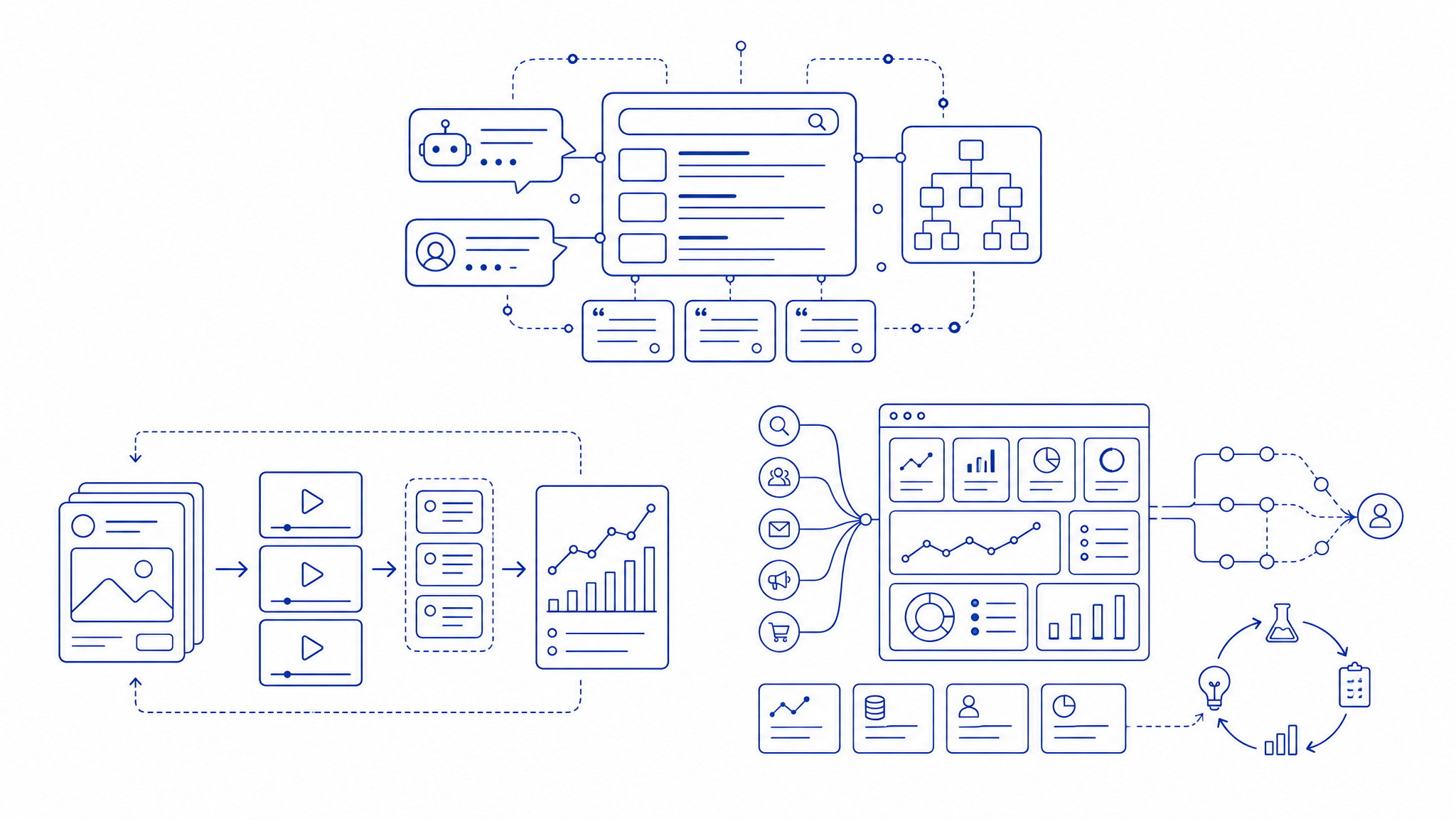
Search is no longer just a list of blue links. Buyers now ask Google, ChatGPT, Perplexity, Claude, Gemini, Reddit, YouTube, and industry-specific communities before they ever land on a vendor website. The result is a new visibility problem: your brand can rank well in traditional search and still be invisible in the answers people actually trust.
AI search optimization is not about gaming language models. It is about making your expertise easy to understand, cite, summarize, and verify. The brands that win in 2026 will not be the ones publishing the most generic blog posts. They will be the ones building clear topical authority, original evidence, and content structures that both humans and machines can navigate.
What AI Search Changes
Traditional SEO rewarded pages that matched keywords, earned links, and satisfied search intent. Those factors still matter. But AI search adds another layer: answer engines need to decide which sources are trustworthy enough to synthesize into a response.
That changes the job of content marketing in three ways:
- Entities matter more than keywords. Search systems need to understand who you are, what you do, which topics you own, and how your content connects.
- Evidence matters more than volume. Generic explanations are easy to generate and easy to ignore. Original frameworks, benchmarks, examples, tools, and data points are harder to replace.
- Structure matters more than prose alone. Clear headings, definitions, comparisons, tables, FAQs, and internal links help both readers and retrieval systems understand the page.
AI search does not eliminate SEO. It makes weak SEO more obvious.
The New Visibility Surface
Marketers should think about AI search as a set of overlapping surfaces, not a single channel.
Google AI Overviews
Google still drives enormous discovery volume, but the answer layer changes the click dynamic. If the query can be answered directly, users may never click. If the query requires evaluation, comparison, or action, users still click — but they click sources that look credible, specific, and useful.
Your goal is not just to rank. Your goal is to become the kind of source that Google can confidently cite.
ChatGPT and Claude
Chat-based assistants are strongest when users ask for recommendations, explanations, workflows, and decision support. They reward content that has clear positioning and strong conceptual structure. If your site has ten disconnected articles that all say similar things, the model has little reason to identify you as an authority.
Perplexity and other answer engines
Perplexity-style search makes citations highly visible. This is where clean, source-like content can perform well: definitions, tactical frameworks, comparisons, calculators, benchmarks, and guides with obvious expertise.
Reddit, YouTube, and community search
AI tools often rely on public discussion signals because buyers trust lived experience. That means brand visibility increasingly depends on how your ideas travel outside your own domain. Content that is actually useful gets discussed, quoted, and reused. Content that is merely optimized does not.
Build Topic Architecture, Not Isolated Articles
The biggest mistake teams make is treating AI search as another checklist. Add FAQ schema. Mention ChatGPT. Write “for AI search” in the title. That is not a strategy.
A better approach is to build topic architecture.
Start with a pillar that matters commercially. For Wieldr, examples include AI marketing, paid social creative, marketing analytics, conversion optimization, and growth strategy. Then build supporting content around each pillar:
- definitions and glossary pages
- strategic guides
- tactical playbooks
- calculators and tools
- case-study-style examples
- comparison pages
- update posts when the market changes
Each piece should answer a specific job. Together, they should make it obvious that your site owns the topic.
A strong topic cluster also has a clear internal linking pattern. The pillar explains the market, supporting pages answer narrower questions, and tools or templates give people something to use. Do not rely on a blog feed to communicate this structure. Link deliberately: from the pillar to the supporting assets, from each supporting asset back to the pillar, and between related subtopics where the next question is obvious.
For example, a paid social creative cluster might include:
| Asset | Job |
|---|---|
| Performance creative pillar guide | Explain the full system |
| Creative fatigue article | Answer a recurring diagnostic question |
| Meta Ads testing framework | Show how to run experiments |
| Creative brief template | Convert interest into action |
| Benchmark or teardown | Add original evidence |
That is much stronger than five disconnected posts that all repeat the same advice.
The Content Formats AI Search Can Use
Not every article needs to be long. In fact, AI search often benefits from content that is modular and easy to extract.
High-value formats include:
Framework pages
A good framework gives the market language. Instead of “how to improve reporting,” publish a decision framework: which metrics matter at which stage, which dashboards should exist, and which decisions each dashboard supports.
Comparison pages
Buyers ask assistants to compare options constantly. Create honest comparison content: channel vs channel, metric vs metric, model vs model, platform vs platform. Do not make every comparison magically end with your preferred answer. Credibility compounds.
Calculators and tools
Tools create interaction data, earn links, and give answer engines something concrete to recommend. A ROAS calculator, CAC calculator, or budget planner is more useful than another definition of performance marketing.
Benchmarks and ranges
AI systems love grounded numbers, and so do buyers. If you can publish realistic ranges — conversion rates, CAC payback periods, creative testing volumes, budget allocations — you create citation-worthy material.
FAQs with real questions
Most FAQ sections are fake. Use questions sales teams actually hear. Use questions from Search Console. Use questions from customer calls. Answer them directly.
On-Page Structure Still Matters
AI search does not mean you can ignore fundamentals. The content still needs to be readable, crawlable, and internally connected.
A practical checklist:
- Use one clear H1 that matches the page’s job
- Write a specific meta description, not a vague teaser
- Use descriptive H2s that could stand alone in an answer
- Define key terms before using them heavily
- Add tables where comparison matters
- Link to supporting articles with descriptive anchor text
- Include author, date, and visible expertise signals
- Keep pages fast and mobile-friendly
- Make CTAs useful, not desperate
This is not glamorous. It works.
For AI search specifically, make the most important claims easy to lift and verify. A page should include a direct definition near the top, a concise summary of the framework, and examples that prove the advice is not abstract. If the page explains a process, include the steps. If it compares options, include a table. If it makes a claim, show the source, example, or reasoning behind it.
Schema can help, but it will not rescue vague content. Use structured data for articles, FAQs, breadcrumbs, products, organizations, authors, and tools where it accurately describes the page. Treat schema as clarification, not decoration.
The Role of Original Evidence
The easiest content to replace is content that explains what everyone already knows. If your article could be generated from the top ten search results, it is not defensible.
Add original evidence wherever possible:
- screenshots from real workflows
- anonymized campaign examples
- before/after metrics
- templates
- decision trees
- proprietary scoring models
- short expert commentary
- mistakes you see repeatedly in client accounts
Even small original observations help. A sentence like “In most Meta accounts we review, creative fatigue shows up in frequency and CPA before CTR collapses” is more valuable than a generic paragraph about testing ads.
The best evidence is specific enough that a competitor cannot copy it without doing the work. Examples:
- “We reviewed 42 ecommerce Meta accounts and saw fatigue first in spend concentration, not CTR.”
- “Our CAC calculator uses payback, gross margin, and repeat purchase rate instead of ROAS alone.”
- “Here is the before/after dashboard from a real reporting cleanup, with client data anonymized.”
That kind of material gives humans a reason to trust you and answer engines a reason to cite you.
How to Measure AI Search Performance
Measurement is messy because answer engines do not all provide clean referral data. But you can still track directional progress.
Watch these signals:
| Signal | What It Indicates |
|---|---|
| Branded search growth | More people discover you elsewhere and search directly |
| Referral traffic from AI/search tools | Early evidence of answer-engine visibility |
| Search Console impressions for informational queries | Topical footprint is expanding |
| Assisted conversions from content | Content is influencing demand, not just traffic |
| Backlinks and mentions | Your frameworks are being reused |
| Tool usage | Visitors are moving from reading to action |
Do not over-optimize for AI referrals yet. The bigger goal is to build a content asset base that keeps earning discovery as interfaces change.
Also track query and mention quality, not just volume. Ten visits from people asking “best agency for Meta Ads creative testing” can be more valuable than a thousand generic visits for “what is SEO.” AI search tends to compress discovery into fewer, higher-intent interactions. Your measurement should reflect that.
AI Search Readiness Checklist
Use this before publishing or refreshing an important page.
- Can a reader understand the page’s answer in the first 30 seconds?
- Does the page name the entities clearly: brand, author, product, category, market, and use case?
- Does it include at least one original example, benchmark, template, tool, or decision framework?
- Are key claims supported by evidence, screenshots, calculations, or visible reasoning?
- Are definitions, comparisons, steps, and FAQs formatted so they can be extracted cleanly?
- Does the page link to the next most useful supporting assets?
- Is the author, date, company, and contact path clear?
- Would a buyer trust the page if it appeared as a citation in an AI answer?
If the answer is no, the page probably needs more substance before it needs more optimization.
A 30-Day AI Search Sprint
If you want to move quickly, start here.
Week 1: Audit your existing content by topic. Identify pages that rank, pages that convert, and pages that have no clear job.
Week 2: Pick one commercial pillar and build a hub. Add internal links, update outdated pages, and create one strong pillar guide.
Week 3: Add two supporting assets: one comparison page and one practical tool or template.
Week 4: Add FAQ content, improve schema, refresh titles/descriptions, and review Search Console data for new query patterns.
The point is momentum with structure. Publishing ten disconnected articles is less valuable than making one pillar undeniably strong.
The Bottom Line
AI search rewards brands that are easy to understand and hard to replace. That means clear positioning, strong topic architecture, practical tools, original examples, and content that helps buyers make decisions.
The old content playbook was “publish more.” The new one is “become the best source for a topic.” That is harder. It is also much more defensible.
Key Terms in This Article
CPA
Cost Per Acquisition – how much you pay to acquire one customer or conversion.
CTR
Click-Through Rate – the percentage of people who click your ad after seeing it.
ROAS
Return On Ad Spend – revenue generated for every dollar spent on advertising.
CAC
Customer Acquisition Cost – the total cost to acquire one new customer.
SEA
Search Engine Advertising – same as SEM, primarily used in Europe.
ARR
Annual Recurring Revenue – the yearly value of subscription revenue.
Related Articles
LLM-Optimized SEO in 2026: Building Content Architecture for Google and AI Assistants
A practical framework for marketing teams that want both Google rankings and AI search visibility. Learn how to structure content, signals, and workflows so your pages become discoverable to both algorithms.
First-Party Data Strategy: The 2026 Playbook
A practical first-party data strategy for 2026: collection, consent, server-side tracking, and CDP activation.
Marketing Metrics That Actually Drive Growth: The Complete 2026 Guide
Impressions and clicks don't pay the bills. Here are the 15 metrics that actually predict revenue growth—and how to track them without drowning in data.
Need help turning this into a system?
Wieldr works with selected teams on strategy, paid media, measurement, creative testing, and AI-native marketing workflows.
Work with Wieldr